New report on asthma severity by Asthma UK

While I welcome the fact that Asthma UK (https://bit.ly/2muKIFh)  have drawn attention to the fact that patients with severe asthma are not well managed in the UK,  however, I am surprised that the authors failed to cite the well known findings of the American Thoracic Society/European Respiratory Societytask force findings on asthma control and exacerbations where the terms ‘control’ and ‘severity’ were defined and accepted in an official statement by the two organisations. (1) In the UK due to the Quality Outcomes Framework, the basis for general practitioners pay, it has become standard practice to simply assess a patient’s asthma once a year, where they are asked about current symptoms – not a good basis for assessing control in a chronic disease defined by fluctuations in symptoms and airflow obstruction from day to day throughout the year!

The report also fails to acknowledge that the international Global Initiative in Asthma (GINA) (2)  Strategy document which is used as the basis for national guidelines in most countries in the world. GINA has since 2009 included a definition of asthma severity and control (the latter includes both current symptoms and future risk of attacks) ; where asthma severity is defined as the amount of treatment needed to maintain control (including the risk elements eg of previous attacks – Table 2-2 GINA many of these risk factors are included in Table 11 SIGN/BTS 153).  (3)

Furthermore, the report states in conclusion that it is “worrying that, four years later, many of the problems identified in the NRAD report (4) have not been addressed”. In fact it’s not worrying, it is incomprehensible! Deaths due to asthma continue at a higher level than most developed countries (5) and is the highest for childhood asthma in Europe.  (6) Of the 19 (NRAD) recommendations only one has been partially implemented nationally. The NRAD found that (similar to findings in the last 50 years) risk of future asthma attacks was not recognised, that patients were undertreated and that guidelines were not followed. Furthermore asthma severity (31% of the deaths were considered severe) was empirically defined without reference by clinicians at that stage to the only published definitions of severity detailed above.

I agree that there is a need to define severity and to accurately determine the numbers of patients with true severe asthma so they can be adequately treated, however, there is an equally pressing need to optimise therapy and management of all people with asthma by implementing the other 18 NRAD recommendations. By optimising treatment and management to include ensuring every person with asthma has a personal asthma action plan, such as the excellent one produced by Asthma UK, and also by identifying risk factors (2-4) and including their presence in defining asthma control (2) rather than simply asking patients how they are once a year, we may then progress towards reducing asthma attacks and identifying and quantifying the levels of asthma severity in the UK.

  1. Reddel HK, Taylor DR, Bateman ED, Boulet LP, Boushey HA, Busse WW, et al. An official American Thoracic Society/European Respiratory Society statement: asthma control and exacerbations: standardizing endpoints for clinical asthma trials and clinical practice. Am J Respir Crit Care Med. 2009;180(1):59-99. https://www.atsjournals.org/doi/full/10.1164/rccm.200801-060ST
  2. The Global Strategy for Asthma Management and Prevention, Global Initiative for Asthma (GINA).2018 http://www.ginasthma.org.
  3. British Thoracic Society, Scottish Intercollegiate Guideline Network. SIGN 153 – The British Guideline on the Management of Asthma. 2016 [Available from: https://www.brit-thoracic.org.uk/document-library/clinical-information/asthma/btssign-asthma-guideline-2016/
  4. Why asthma still kills: the National Review of Asthma Deaths (NRAD) Confidential Enquiry report Royal College of Physicians. London; 2014 https://www.rcplondon.ac.uk/projects/outputs/why-asthma-still-kills
  5. Global Asthma Network. The Global Asthma Report 2014. 2014. Available from: http://www.globalasthmareport.org/resources/Global_Asthma_Report_2014.pdf
  6. Wolfe I, Thompson M, Gill P, Tamburlini G, Blair M, van den Bruel A, et al. Health services for children in western Europe. The Lancet. 2013;381(9873):1224-34.

Asthma Admissions: Inherent Bias in favour of Hospitals & Urgent Care Centres


One of the major problems in the United Kingdom is the cost of preventable recurrent treatment for people with asthma attacks in hospitals, Accident & Emergency Departments (EDs) and Urgent Care Centres.

Commissioners actively encourage General Practitioners to reduce admissions however, it is not in the interest of the providers, simply because they will lose income. That is possibly one of the major reasons that up to 10% of adults and 15% of children and young people are readmitted or re-attend for emergency care for asthma within 6 and 12 weeks of treatment. Similarly, downward pressure on GPs to prescribe expensive preventer medication for asthma results in increased attacks and secondary care utilisation – so savings in prescribing are translated into increased unscheduled care costs.

Sadly, successive governments have failed to tackle this problem by persisting with allocation of separate  budgets to the primary & secondary care sectors. This is also due to the loss of the ‘National’ in the NHS. Instead of a centralised, long term forward plan for managing health care, we have to undergo major wasteful change every time a new Minister for Health is appointed.

It really is time for change! My suggestions:

i) Stop paying Hospitals, A&E Departments and Urgent Care Centres if patients re-attend for asthma exacerbations within 4 weeks. ii) Lets have a referendum – ‘ Politicians IN or OUT of the National Health Service’

Enough oral steroids for asthma attacks

Introduction

Oral steroids (corticosteroids) are needed when treating acute asthma attacks

Oral steroids are usually needed for treating acute asthma attacks. Most importantly they should be continued until the attack (exacerbation) has resolved.

Treatment of acute asthma exacerbations

Asthma attacks (also known as exacerbations) should be managed by treating the acute symptoms with drugs; and also by establishing why the person had an attack; and whether any preventable risk factors can be addressed to regain control. In my opinion, and the findings of the NRAD, not enough effort is put into the last two aspects of treatment of asthma attacks. In this item, I discuss the drugs and will address the other issues in a later blog.

Note for people with asthma and families:

This blog  is not intended as medical advice for individual people with asthma. Always consult your own doctor for advice, but please do feel free to  use this blog as a basis for discussion.

Drug treatment of asthma attacks includes

  • High doses of reliever medication (short acting bronchodilators, salbutamol – usually delivered via an oxygen driven nebuliser or a blue inhaler using a spacer device.)
  • Oxygen (Ideally used to drive a nebuliser at flow rates over 6L/min)
  • Corticosteroids (prednisolone, cortisone) –  life saving drugs during attacks which help to clear up the inflammation that occurs before and during attacks.

Corticosteroid tablets or injections take about 6 hours to work

So its really important to start the oral corticosteroids as soon as possible. however there are often delays in starting these drugs in hospital so an obvious solution is to provide patients with a course of oral corticosteroids so they can start these themselves.

No one knows how long an asthma attack lasts

Many doctors prescribe oral corticosteroids for 3, 5 or 7 days without any follow up evaluation. This is illogical since no one can predict how long an attack will last.

Tamara Mills had 47 asthma attacks in her last 4 1/2 years of life

24/47 were attendances at A&E (ED) and 21/47 were hospital admissions

With permission of Tamara’s mother I share her sad story. Tamara died just before her 14th birthday. Of her 47 flare-ups (Attacks/exacerbations) 20 were re-attendances due to incomplete treatment of attacks. With the exception of one of these attacks she was prescribed 3 or 5 days of oral corticosteroids without any follow up by an asthma doctor. The only time she got 14 days post attack treatment was after she had a near fatal attack while in hospital.

A respiratory paediatrician was fortuitously on duty on one occasion

The morning after Tamara was resuscitated after having a life threatening asthma attack while in hospital she saw a paediatrician with a special interest in asthma for the first time

This was the only time she got 14 days of oral corticosteroids for acute asthma

Tamara was prescribed 14 days of prednisolone (oral corticosteroid) only once. This was the only time her asthma was taken seriously. That was by chance because she saw a paediatrician with a special interest in asthma that morning. See the coroners report here. However, she was never referred to an asthma specialist after this admission to hospital.

Why it is inappropriate to prescribe oral steroids for a fixed time

The problem being that a proportion of people have another attack soon after being treated for one. One of the explanations for this is that the first attack wasn’t treated until completely resolved . For more on this see here.

Conclusion

So what do people with asthma and health professionals need to do in order to try to reduce the number of preventable asthma attacks?

In my opinion, three things:

  1. People treated for asthma attacks should see their doctor (or asthma nurse) before they run out of corticosteroid (cortisone) tablets so they can be advised whether their attack has resolved, whether to continue or stop these tablets and also so that the health professional can identify what went wrong/what led to the attack and optimise the treatment.
  2. To be provided with a peak flow meter and symptom diary chart when sending someone home after treatment of an asthma attack. This could help patients, their carers and health care professionals determine whether the attack has resolved based on the readings as well as symptoms. These readings can help decide when the attack is over and when to discontinue corticosteroids.
  3. The health care professional should do a detailed asthma review (see here how to do a post attack review)after the attack to determine what went wrong and to optimise treatment based on the assessment.

Asthma is not an acute disease

By definition asthma is a chronic, ongoing disease prone to intermittent flare-ups requiring treatment. Yet the National Review of Asthma Deaths (NRAD) and more recent deaths due to asthma (such as the case of Tamara Mills described in this Blog) have demonstrated that asthma is being treated as if its an acute, short lived disease.

Most asthma attacks are preventable and more importantly are a signal that something has gone wrong and that  the person’s chronic underlying asthma is not being adequately managed.

Attacks are often treated as isolated events without follow-up or optimisation of chronic treatment. What often happens is that patients suffering from asthma attacks or flare-ups are prescribed a fixed period of corticosteroid tablets (for 3, 5 or 7 days) without arranging a review in two working days,  as stipulated in the BTS/SIGN Guideline. The problem being that no one knows how long an asthma attack will last, and without a review before patients run out of the corticosteroid tablets, the high numbers of re-admissions and re-attendances for persisting attacks will continue.

Asthma reviews are intended to provide opportunities for clinicians to assess current control as well as the risk of future attacks and to optimise treatment to gain control and reduce risk of future attacks.

In the UK, meeting the requirements of the Quality Outcomes Framework, which provides a proportion of GPs pay, includes an annual asthma review. Unfortunately, many clinicians interpret this single annual review as sufficient for monitoring people with asthma. As asthma is a chronic relapsing disease, this is a ludicrous assumption –  people with asthma should be reviewed more frequently, at least every time treatment is changed and certainly after an attack or flare-up.

Asthma reviews:

A thorough asthma review  opportunistically, after attacks, and also at regular intervals  provides a method for maintaining control of the disease and ending asthma attacks, and deaths.Post attack reviews have long been recommended, within two working days after the attack irrespective of where this is treated (ie by the patient, in the GP surgery or in hospital or emergency departments).

  • to assess current control; and also
  • to find out what went wrong, to establish whether there are any risk factors for future attacks and most importantly to optimise care

PostAttackReview

It is really important to understand that current symptom control – i.e presence of daytime or night-time symptoms, or limitation of activity due to asthma (as measured by using the RCP 3 Questions or similar instruments) – only provides a clinician with information on how the patient’s asthma is currently controlled at the time of the assessment. While it is clear that someone who has got current asthma symptoms is at risk and needs urgent optimisation of treatment, the converse is not true.

Someone who has good current asthma control (no symptoms or limitation of lifestyle) may still be at risk of future attacks and as recommended in the NRAD, and the GINA Strategy document – Table 2-2, and the BTS/SIGN Guideline – Table 11,   risk must be assessed during a review, as a component of the overall assessment of asthma control .

Examples of risk factors include identification of triggers (such as food allergy), pregnancy, obesity, requirement for excess reliever bronchodilator medication, low FEV1, poor inhaler technique, the need for 3 or more asthma treatment types, a previous attack, a previous life-threatening attack.

Asthma is a chronic ongoing disease and therefore, treatment should not be limited to managing attacks & flare ups. Treatment must be optimised in those people with poor control, as well as those with good control who also have risk factors for future attacks (detailed in BTS/SIGN, GINA and NRAD – and which include recent attacks; excess reliever use; inadequate preventer use; poor inhaler technique; comorbidities like obesity, allergic rhinitis & food allergy; pregnancy and a past history of a life threatening attack.

How long does an asthma flare up take to resolve?

No one knows how long an asthma attack lasts

No one knows how long an asthma flare up lasts. Asthma flare ups are also known as asthma attacks or an asthma exacerbation. Asthma exacerbations and hospital admissions can be prevented by anti-inflammatory treatment. Well controlled asthma should not flare up.

Doctors often treat attacks for a fixed time period

No one knows how long an asthma attack takes to resolve. However health professionals often treat attacks as if they do! Most asthma guidelines recommend oral corticosteroid treatment for attacks. The UK SIGN Guideline states very clearly that these corticosteroids should be continued until the attack resolves. From my knowledge, most people are treated for attacks with fixed corticosteroid courses of 3, 5 or 7 days. How do these doctors & nurses know the attack will be over in 3, 5 or 7 days?’

Oral corticosteroids should be continued as long as an attack lasts

According to the United Kingdom (BTS/SIGN) Asthma guideline section on treatment of acute asthma attacks/ Flare ups / exacerbations:

  • In Adults: Continue prednisolone (40–50 mg daily) until recovery (minimum 5 days).
  • In Children: Treatment for up to three days is usually sufficient. But the length of course should be tailored to the number of days necessary to bring about recovery. Tapering is unnecessary unless the course of steroids exceeds 14 days.

So the key message is that oral corticosteroids should be continued until the attack is over. The excellent acute asthma section (chapter 9) in the 2019 version of the BTS/SIGN Guideline is essential reading. To download it click here.

How to tell if an asthma attack is over

It may take days or weeks for an asthma flare-up to resolve. An asthma flare up or attack is over when a person is free of symptoms. An asthma attack is not over yet If rescue reliever medication is needed. When the Peak Expiratory Flow or Spirometry has returned to the patients usual best level the attack is over. Therefore treatment for attacks should continue until the attack has resolved.

Asthma is a chronic ongoing disease – not an acute disease

Asthma is a chronic ongoing disease, nonetheless it is often treated as if it is an acute illness. The attack is usually treated very well although, surprisingly, a large majority of these people are not followed up for a review to identify and deal with any modifyable features.

An asthma flare up or attack means something has gone wrong

Someone whose asthma is appropriately treated with preventer medication, should be free of attacks, and therefore an attack signals a failure of treatment. In addition, asthma attacks are a well known risk factor for future attacks and therefore people are most vulnerable after an attack.

It follows that clinicians should aim to ensure that after asthma attacks are resolved that any modifiable factors are identified and dealt with to try and prevent another attack. Listen to my asthma podcast (second from bottom) here. This is one of the two main purpose of a post attack review.

Post asthma attack reviews

The purpose of the post attack review is:

i) to assess the progress of the current attack to determine the need for treatment. Including:

  • assessing current symptoms for example using the Asthma Control Test (ACT),
  • requirement for reliever treatment,
  • night time symptoms including waking due to asthma
  • lung function (Peak Flow or spirometry).
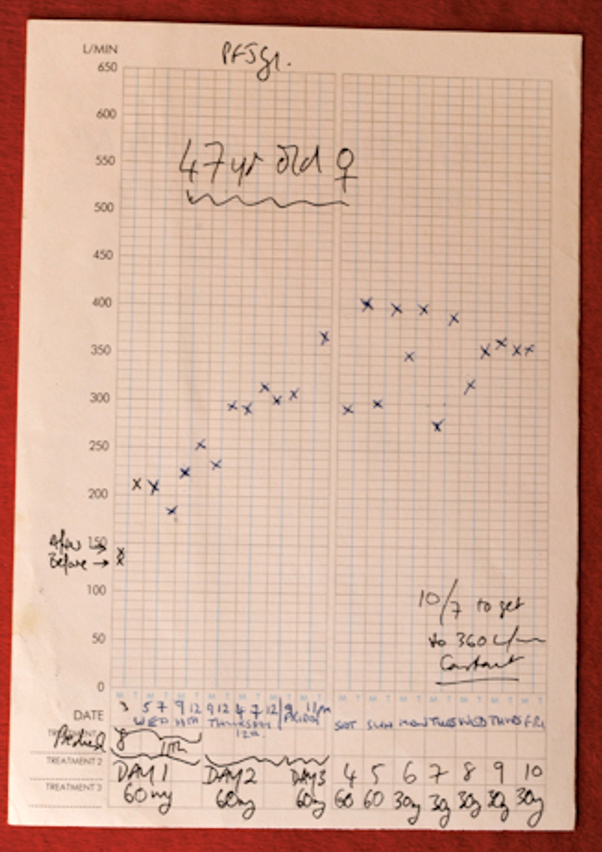
Peak flow chart showing when an attack was over
Peak flow chart showing resolution of an asthma attack. This woman presented for the first time with an asthma attack. I did not know what her normal peak flow was so we used a peak flow chart to inform us when it would be safe to stop her oral corticosteroids

ii) to identify modifiable risk factors causing the attack and optimise care. Modifiable risk factors include:

  • failure by doctors to prescribe controller medication (mainly inhaled corticosteroids);
  • failure by patients to refill prescriptions for controller medication,
  • excess reliever prescriptions and over-reliance by patients on these.
  • For more information on modifiable risk factors see GINA Table 2-2 and Table 11 (page 82)  in the BTS/SIGN Guideline).

More details on post attack reviews here.

Conclusion

Keep patients safe and reduce GP’s workload by using post attack reviews to maintain asthma control.

An asthma attack signals something needs to change. Identifying modifiable risk factors and dealing with them will reduce future attacks. This will help to prevent asthma flare ups, hospital admissions and avoidable deaths. When should post asthma attack reviews be done? Ideally before the oral corticosteroids run out or within a week. Many primary care colleagues argue that this is not feasible due to heavy worlkload. A practical solution is to simply block off one appointment every afternoon for a post asthma attack review. If not taken up by midday it could be used for another patient that day.

Coroner’s report-action to prevent asthma deaths.

Following the inquest of the death due to asthma of Tamara Mills, aged 13 years, the coroner has encapsulated the essence of what went wrong in the care of this child. The coroners call for action to prevent future attacks and deaths, provides an urgent opportunity for health professionals to make a difference and improve the care of people with asthma.

Tamara Mills – Regulation 28 report to prevent future asthma deaths

Listen to podcasts numbers 18, 19 and 20

Three asthma podcasts on preventing asthma deaths address many of the lessons learned from the NRAD and the deaths of Tamara Mills and a number of other preventable deaths due to asthma – listen to them here.

Preventable Asthma deaths – 2023 still no national action in the UK

Towards the end of 2014 I was asked, through the Royal College of Physicians if I could assist a coroner in the matter of a 13 year old child, Tamara Mills, who had a preventable asthma death. This child died a few weeks before we published the report on the National Review of Asthma Death (NRAD) entitled “Why Asthma Still Kills” earlier that year.

19 recommendations for change

Over 2/3rds of the deaths in the NRAD were considered to be preventable asthma deaths – they had major preventable factors. The report, commissioned by the Healthcare Quality Improvement Partnership  (HQIP) on behalf of the four governments of the UK, detailed 17 key findings and made 19 recommendations for change in the care of people with asthma. However in 2023, 9 years since publication of ‘Why Asthma Still Kills” on World Asthma Day, 6th May 2014, no national action has yet been taken to implement the recommendations of the report. Some of these were relatively simple and others more complex to implement; however, as the report concluded that over two thirds of the people who died from asthma, had factors identified by NRAD clinical assessors (nurses and doctors from primary, secondary and tertiary care, as well as pharmacists) that were potentially preventable, it is very difficult to understand why there hasn’t been a directive from departments of health to commissioning bodies to implement the recommendations.

In fact it was the NRAD report, which was widely publicised, that alerted the coroner that this child’s death had similar features to the preventable factors identified in the NRAD report.

Child’s care was below acceptable standard

The evidence from Tamara’s general practice and hospitals involved with her care was  distressingly clear to me that this child, who had asthma from infancy, had suffered numerous incompletely treated attacks or flare-ups of her asthma in her final 4 ½ years. 

Her chronic asthma was treated as if it was an acute disease

She had, in my view, been managed inconsistently, and her treatment was directed almost exclusively at managing her attacks; which in itself reflected the lack of understanding by the health professionals that asthma is a chronic underlying disease prone to flare-ups and attacks. During these attacks, she was prescribed reliever medication (bronchodilators, salbutamol) and short courses of corticosteroid (cortisone) tablets and sent home, sometimes before she had clearly improved. In the main, she was prescribed the steroids for 3 or 5 days, without any arrangements for follow-up assessment to see if she had recovered from the attacks. The UK BTS/SIGN asthma guideline (section 8.8.4) clearly states that oral corticosteroids (steroid tablets) should be prescribed until the attack has resolved, and this can sometimes take more than a week.

47 asthma attacks in her last 4 1/2 years

In fact, on 20 of the 47 occasions she was treated for asthma attacks, she needed to re-attend at the hospital or her practice because these attacks had not resolved. In her final year of life, she was admitted to hospital for severe asthma attacks on six occasions, and in three of these, she had to be re-admitted, in my view, because her attack had not resolved because it was incompletely treated.

There were many similarities in the case of Tamara Mills, to the findings of the NRAD, these included:

  • Failure to recognise risk of future attacks, including excess prescription of reliever medication
  • Failure to understand that asthma is a chronic condition prone to flare-ups or attacks
  • Failure to follow up patients after treatment of acute attacks
  • Failure to monitor asthma
  • Failure to follow the SIGN/BTS Guidelines
  • Failure to assess lung function

The coroners verdict

The verdict, delivered on the 15th October 2015 by Mr T Carney HM Coroner, Gateshead following the inquest of Tamara Mills was:

  1. Tamara Mills died from an acute severe asthma attack
  2. he made a short statement qualifying this as follows:
    The death of this young woman was a premature death contributed to by a lack of appreciation of, and reaction to, the deteriorating nature of her chronic respiratory condition and by the absence of any planning or co-ordination of her care, failed to prevent her death”.

The coroner issued a Regulation 28 Statement because he considered this child’s death as preventable, read it on the chief coroner’s website here.

The coroner also said: “This condition was not, even as severe as it was and as chronic as it was, in itself a death sentence. It should not have been”.

From the ShieldGazette 17.10.2015

Dawn Wilson, Tamara’s mum said:

“I hope that the recommendations made in relation to the treatment of asthma patients in response to Tamara’s death will be implemented to prevent future deaths and other families suffering as we have. I truly hope that our loss has not been in vain

In 2023 no national action has been taken to implement the NRAD findings

In my opinion the situation with regard to asthma management in the UK is at a critical stage of utter complacency. A directive is needed, on the basis of NRAD and subsequent avoidable deaths of Children and Young People (CYP), like Tamara Mills,  to ensure high quality commissioning of asthma care. In my view it is time for action to ensure a fully resourced, comprehensive, integrated system for asthma education and management in the UK.